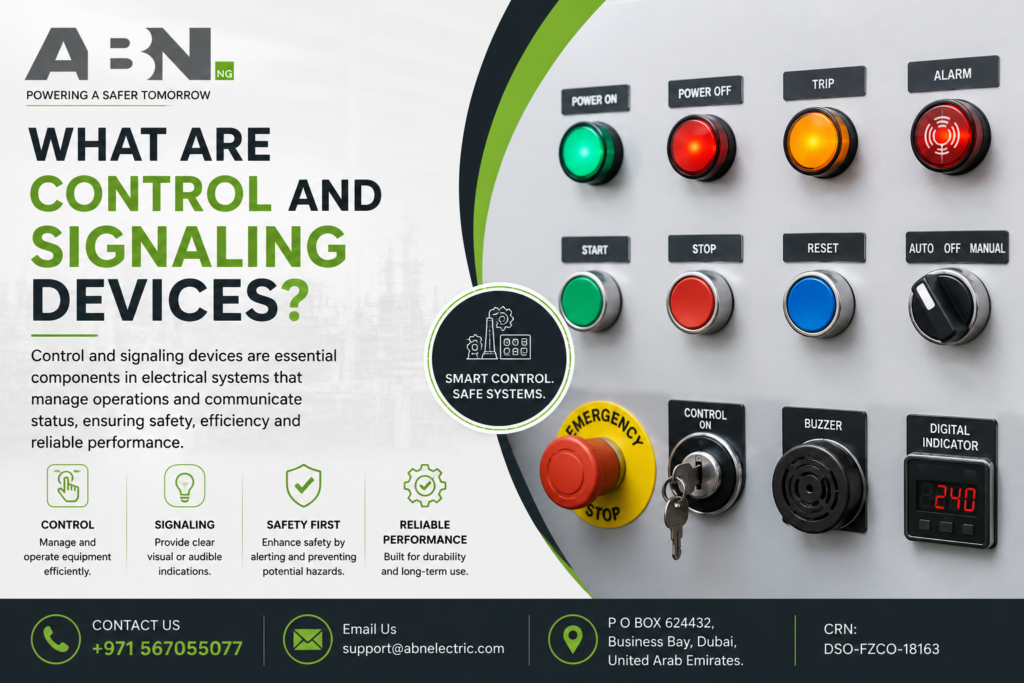
Control and signaling devices are electrical components used to operate, monitor, and manage machines and industrial systems. Control devices initiate or stop actions—like push buttons and selector switches—while signaling devices communicate system status through lights and indicators. Together, they form the backbone of safe, efficient industrial automation.
Every time an operator presses a button to start a conveyor, flips a switch to change a machine’s operating mode, or spots a red light warning them of a system fault—they’re interacting with control and signaling devices. These components are foundational to industrial electrical systems, yet they often go unnoticed until something goes wrong.
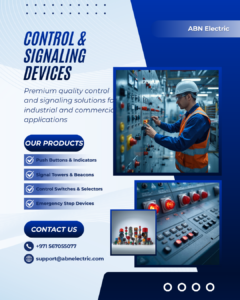
For electrical engineers, plant managers, and system integrators working in Dubai’s growing industrial and manufacturing sectors, understanding these devices is essential. Whether you’re designing a new control panel, specifying components for automation equipment, or sourcing replacements for existing machinery, knowing what these devices do—and how to choose the right ones—directly impacts operational safety and efficiency.
This blog breaks down exactly what control and signaling devices are, the key types you’ll encounter in industrial settings, how they work together in real applications, and what to consider when selecting them.
What Are Control and Signaling Devices?
Control and signaling devices are electrical components integrated into control panels, machinery, and automation systems to manage operations and communicate system status to operators.
The category covers two distinct but complementary functions:
- Control devices allow operators or automated systems to initiate, halt, or modify electrical circuits. Push buttons, selector switches, and emergency stop devices fall into this group.
- Signaling devices provide visual or audible feedback about a system’s operating condition. Pilot lights, indicator lights, buzzers, and stack lights are common examples.
In practice, both types work together within a unified control interface. An operator presses a push button (control) to start a pump, and a green pilot light (signaling) confirms the pump is running. If a fault develops, a red indicator light or audible alarm alerts the operator immediately.
How Do Control Devices Differ From Signaling Devices?
| Feature | Control Devices | Signaling Devices |
| Primary function | Initiate or interrupt electrical circuits | Communicate system status |
| Operator interaction | Input (manual or automated) | Output (visual or audible) |
| Common examples | Push buttons, selector switches, E-stops | Pilot lights, indicator lights, buzzers |
| Power flow | Carries control current | Receives signal from control circuit |
Understanding this distinction helps engineers specify the right components during panel design and simplifies troubleshooting during maintenance.
What Are the Main Types of Control and Signaling Devices?
Push Buttons
Push buttons are among the most widely used electrical control components in industrial environments. They complete or interrupt a circuit when pressed, triggering actions like starting a motor or activating a conveyor system. They come in momentary (spring-return) and latching (maintained) configurations, and are available in various colors—green for start, red for stop—to meet international safety standards.
In the Dubai market, ϕ22.5mm push buttons are the standard format for most control panels and industrial machinery. They’re available in both metal and plastic body versions, offering flexibility for different environmental and aesthetic requirements.
Selector Switches
Selector switches allow operators to choose between two or more operating modes within a machine or system. A typical three-position selector switch might toggle between manual, off, and automatic modes on a production line. Unlike push buttons, selector switches maintain their position until deliberately changed, making them suited to applications where mode selection needs to remain constant.
Emergency Stop Devices
Emergency stop (E-stop) devices are safety-critical control components designed to cut power to a machine immediately when a hazard is detected. They are typically large, red, mushroom-headed buttons that lock in position when pressed. Releasing them requires a deliberate action—usually a twist or key release—to prevent accidental restart.
In industrial settings across Dubai and the wider UAE, emergency stop devices must comply with relevant IEC safety standards. They are a mandatory requirement in most machinery safety designs and control panel configurations.
Pilot Lights and Indicator Lights
Pilot lights are signaling devices that display a machine’s operating state through illuminated lenses. Standard color conventions include:
- Green – machine running or system normal
- Red – fault, stop, or alarm condition
- Amber/Yellow – caution or standby
- Blue – specific conditions as defined by the designer
- White – power on
Modern LED pilot lights offer longer service life and lower energy consumption compared to traditional incandescent versions. For harsh industrial environments in the UAE—where heat and dust are constant factors—sealed and rated enclosures are critical.
Indicator Lights and Stack Lights
Indicator lights perform a similar function to pilot lights but are often used to signal specific system events rather than general operational status. Stack lights (also called signal towers) combine multiple colored lights and sometimes an audible buzzer into a single tower unit, providing a comprehensive at-a-glance status display. These are commonly used on CNC machines, automated production lines, and packaging equipment.
Control Switches and Other Electrical Control Components
Beyond the core types, control and signaling devices also include key switches (which require a physical key to operate, adding a layer of access control), foot switches (used where hands-free operation is necessary), and limit switches (which detect the position of a mechanical component). Each serves a specific role in the broader ecosystem of industrial control devices.
Where Are Control and Signaling Devices Used?
These components appear across virtually every industrial and commercial sector in Dubai and beyond:
Electrical control panels – Control and signaling devices are the primary human-machine interface on most control panels. Push buttons start and stop equipment; selector switches change operating parameters; indicator lights confirm system states.
Manufacturing and production lines – Automated production environments rely on industrial control devices to coordinate machine sequences, trigger safety shutdowns, and provide real-time operational feedback to line operators.
HVAC and building services – Commercial and industrial buildings in Dubai use control switches and indicator lights to manage heating, ventilation, air conditioning, and pumping systems.
Oil, gas, and process industries – In these environments, emergency stop devices and explosion-proof signaling devices are critical safety components, with strict compliance requirements.
Water treatment and utilities – Pumping stations and treatment facilities use a combination of selector switches, push buttons, and status indicator lights to manage complex automated processes.
OEM machinery – Original equipment manufacturers incorporate these electrical control components directly into their machines, ensuring operators have clear, intuitive interfaces.
Why Are Control and Signaling Devices Important for Industrial Safety and Efficiency?
Without reliable control and signaling devices, industrial operations would rely on indirect methods to manage and monitor machinery—a significant safety risk. These components serve three core functions:
- Operator control – They give personnel direct, immediate influence over machine operation, reducing response time in critical situations.
- System visibility – Signaling devices provide continuous, real-time feedback, reducing the need for manual inspection and helping operators detect faults early.
- Safety compliance – Emergency stop devices and safety-rated switches are legal and standards-based requirements in most industrial applications. Their reliability is non-negotiable.
For plant managers and maintenance engineers in Dubai’s industrial zones—including Jebel Ali, Dubai Industrial City, and Al Quoz—selecting high-quality industrial signaling devices and control components directly reduces downtime, lowers maintenance costs, and supports regulatory compliance.
What Should You Consider When Selecting Control and Signaling Devices?
Choosing the right components requires more than matching a part number. Here are the key selection factors:
Environmental rating (IP rating) – Devices used in dusty, wet, or chemically aggressive environments need appropriate ingress protection. IP65 or higher is typical for outdoor or washdown applications common in UAE industrial facilities.
Voltage and current ratings – Components must match the electrical specifications of the control circuit. Mismatched ratings lead to premature failure or unsafe operation.
Actuator type and size – The standard ϕ22.5mm format is widely adopted, but application-specific requirements—like flush buttons for accidental-press prevention or extended mushroom heads for E-stops—must be considered.
Material and body construction – Metal-bodied devices offer greater durability in heavy industrial environments; plastic versions are cost-effective for lighter-duty or panel-mount applications.
LED vs. incandescent lamps – LED versions are the preferred choice for new installations due to their longer lifespan, lower heat output, and energy efficiency—particularly relevant in Dubai’s warm climate.
Standards compliance – Devices should meet IEC 60947-5-1 (for control circuit devices) and relevant safety standards applicable to the specific industry.
Modularity and availability – Selecting components from established product families ensures long-term availability of spares and accessories, simplifying future maintenance and expansion.
When in doubt, consulting with a specialist supplier like ABN helps ensure the right fit for your specific application, whether you’re specifying components for a new panel build or replacing legacy devices on existing equipment.
The Right Components for Dubai’s Industrial Demands
Dubai’s industrial landscape is expanding rapidly—from logistics and manufacturing to utilities and process industries. Every new facility and automated system requires well-specified, reliable electrical control and signaling solutions. The demand for quality, standards-compliant industrial control devices is only growing.
ABN supplies a comprehensive range of control and signaling devices suited to these industrial requirements, including ϕ22.5mm push buttons and lamps in metal and plastic versions, push button stations in 1P, 2P, 3P, and 4P configurations, and 40mm emergency stop buttons. Whether you’re an electrical contractor, panel builder, system integrator, or procurement professional, ABN provides the technical product knowledge and product range to support your projects across Dubai and the UAE.
Frequently Asked Questions
What is the difference between a control device and a signaling device?
A control device—such as a push button or selector switch—allows an operator to input a command that affects a circuit or machine. A signaling device—such as a pilot light or indicator—outputs information about the system’s current state. Both are typically used together within the same control interface.
What are the most common types of control and signaling devices used in industrial control panels?
The most commonly specified components include push buttons, selector switches, emergency stop buttons, pilot lights, and indicator lights. Stack lights are also widely used where multi-status visibility across a work area is required.
What IP rating should I specify for control and signaling devices in harsh environments?
IP65 is the minimum recommended rating for environments exposed to dust and water jets—common in manufacturing, food processing, and outdoor installations. For more aggressive chemical environments, higher IP ratings or specific material specifications may be needed.
How can ABN help me select the right control and signaling devices for my project?
ABN’s team can assist electrical engineers, contractors, and procurement professionals in identifying suitable components based on application requirements, environmental conditions, and compliance standards. Contact ABN directly through their website to discuss your specific project needs.
Get Expert Guidance From ABN
Specifying the right control and signaling devices for an industrial or commercial application requires a clear understanding of your operational environment, safety requirements, and system design. Choosing the wrong components leads to costly downtime, compliance failures, and safety risks.
ABN works with electrical engineers, system integrators, panel builders, and procurement teams across Dubai and the UAE to supply reliable, standards-compliant electrical control and signaling solutions. If you need technical guidance or product support for your next project, contact ABN today and speak with a specialist who understands your requirements.