
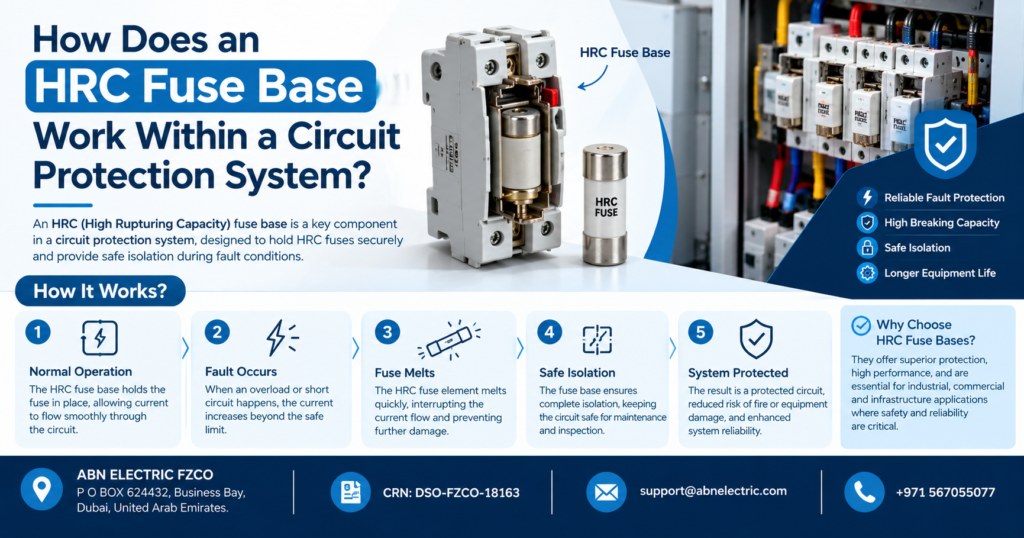
Quick answer: An HRC (High Rupturing Capacity) fuse base is the mounting unit that holds an HRC fuse link in place and connects it to the circuit’s live conductors. It provides a secure, insulated housing that allows the fuse to interrupt fault currents safely, protecting equipment and wiring from damage caused by short circuits or overloads.
Electrical faults happen fast, often within milliseconds, and the difference between a minor inconvenience and a costly disaster comes down to how well your circuit protection system responds. HRC fuse bases play a quiet but critical role in this response. While the fuse link itself gets most of the attention, the base it sits in determines how safely and reliably that fuse can do its job.
This post breaks down what an HRC fuse base actually does, how it works alongside the fuse link, and why choosing the right base matters just as much as choosing the right fuse. Whether you’re an electrician specifying parts for a switchboard or a facilities manager trying to understand your building’s protection system, this guide will help you make sense of the components keeping your circuits safe.
What is an HRC fuse base?
An HRC fuse base is the fixed mounting component that holds an HRC fuse link and connects it to the incoming and outgoing conductors of a circuit. Think of it as the socket, while the fuse link is the removable, replaceable part that actually breaks the circuit during a fault.
HRC fuse bases are typically made from durable, non-conductive materials like porcelain or heat-resistant thermoplastic, with metal contact clips or jaws that grip the fuse link firmly. This design allows the fuse link to be swapped out after it blows, without needing to replace the entire assembly or rewire the circuit.
HRC fuses are named for their ability to safely interrupt very high fault currents without shattering or causing secondary damage, which is what “High Rupturing Capacity” refers to. The base is engineered to match this capability, maintaining a stable connection under normal load while withstanding the mechanical and thermal stress of a fault event.
How does an HRC fuse base function during normal operation?
During normal operation, the HRC fuse base does two main jobs: conducting current and holding the fuse securely.
The base’s metal contacts grip the fuse link’s end caps tightly, creating a low-resistance connection between the incoming supply and the outgoing circuit. This tight contact matters because loose or corroded connections generate heat, and excess heat can degrade both the fuse and the base over time.
Because the base is rated for a specific voltage and current capacity, it’s designed to handle continuous load without overheating. Choosing a base with a rating that matches your fuse link and circuit requirements is essential. A mismatch, such as using an undersized base with an oversized fuse, can create a weak point in the system long before the fuse ever needs to activate.
What happens inside an HRC fuse base during a fault?
When a fault current—like a short circuit or severe overload—flows through the circuit, the fuse link inside the base is what actually responds, not the base itself. The fuse element, usually a thin strip of silver or another conductive material, heats up rapidly and melts, breaking the circuit and stopping current flow.
The base’s job during this event is structural and protective. It needs to:
- Contain the arc. As the fuse element melts, an electrical arc can form. HRC fuse links are filled with a granular filler (usually sand) that quenches this arc quickly, and the base must maintain a stable housing that supports this process without breaking down.
- Withstand thermal stress. The base is built to tolerate the sudden heat generated during fuse operation without cracking, warping, or degrading.
- Keep contacts isolated. Once the fuse has blown, the base keeps the circuit safely open until the fuse link is replaced, preventing any accidental re-energizing of the faulty section.
This is why base quality matters just as much as fuse quality. A poorly made base can fail to contain an arc properly, creating a safety hazard even if the fuse link itself performs correctly.
Why does the fuse base matter for overall circuit protection?
Circuit protection systems rely on several components working in sync: the fuse link, the fuse base, the switchboard or panel, and the wider electrical network. If any one part underperforms, the whole system is compromised.
Choose an HRC fuse base with a higher-than-expected rating if your circuit experiences frequent load fluctuations or if you’re planning future capacity upgrades. This gives you a margin of safety and reduces the risk of needing to replace the base later.
On the other hand, a standard-rated HRC fuse base is usually sufficient for stable, well-characterized loads, such as fixed lighting circuits or dedicated equipment feeds, where current draw is predictable.
Poorly maintained or aging fuse bases are also a common, overlooked cause of electrical faults. Corrosion, loose contacts, or physical damage to a base can create resistance that generates heat even under normal conditions, sometimes triggering nuisance fuse operation or, worse, failing to protect the circuit at all during an actual fault. Regular inspection of fuse bases, not just fuse links, should be part of any electrical maintenance routine.
What should you check when selecting an HRC fuse base?
When specifying or replacing an HRC fuse base, a few factors determine whether it’s the right fit for your application:
- Current rating. The base must be rated to handle the maximum current of the fuse link it will house, plus the expected load of the circuit.
- Voltage rating. Match the base’s voltage rating to your system voltage, with an appropriate safety margin.
- Physical size and mounting type. HRC fuse bases come in standard sizes to fit specific fuse link dimensions, so compatibility with existing switchboards or panels is essential.
- Material and environmental rating. For outdoor or industrial environments, check that the base’s housing material can withstand moisture, dust, or chemical exposure.
- Compliance with relevant standards. Look for bases that meet recognized electrical safety standards for your region, as this ensures the component has been tested for reliable performance under fault conditions.
Keeping your circuit protection system reliable
An HRC fuse base might not be the most talked-about component in an electrical system, but it’s foundational to how reliably that system protects people, equipment, and property. Pairing a well-rated fuse link with a properly matched, well-maintained base is one of the simplest ways to strengthen your circuit protection setup.
If you’re upgrading a switchboard, replacing aging components, or specifying parts for a new installation, take the time to check that your fuse bases match your fuse links and your circuit’s demands. A quick inspection now can prevent costly downtime, equipment damage, or safety incidents later. For guidance on selecting the right HRC fuse base for your specific application, consulting a licensed electrician or your fuse manufacturer’s technical specifications is always a smart next step.
Frequently asked questions
What’s the difference between an HRC fuse and an HRC fuse base?
The HRC fuse (or fuse link) is the replaceable component that melts and interrupts current during a fault. The HRC fuse base is the fixed housing that holds the fuse link and connects it to the circuit’s conductors.
How long does an HRC fuse base last?
A quality HRC fuse base can last for many years, even decades, if kept clean, dry, and free from corrosion. However, it should be inspected regularly and replaced if contacts become loose, damaged, or discolored from heat.
Can I use any HRC fuse link with any HRC fuse base?
No. The fuse link and base must match in size, current rating, and voltage rating. Using an incompatible combination can result in poor contact, overheating, or failure to protect the circuit properly.
Is it safe to replace a fuse base myself?
Fuse base replacement involves working with live electrical components and should only be performed by a licensed electrician, particularly in commercial or industrial settings where fault currents can be substantial.
What are the risks of using a damaged or corroded fuse base?
A damaged fuse base can create resistance and heat under normal load, potentially causing nuisance fuse blowing or, in worse cases, failing to properly contain an arc during an actual fault, creating a fire or safety hazard.