
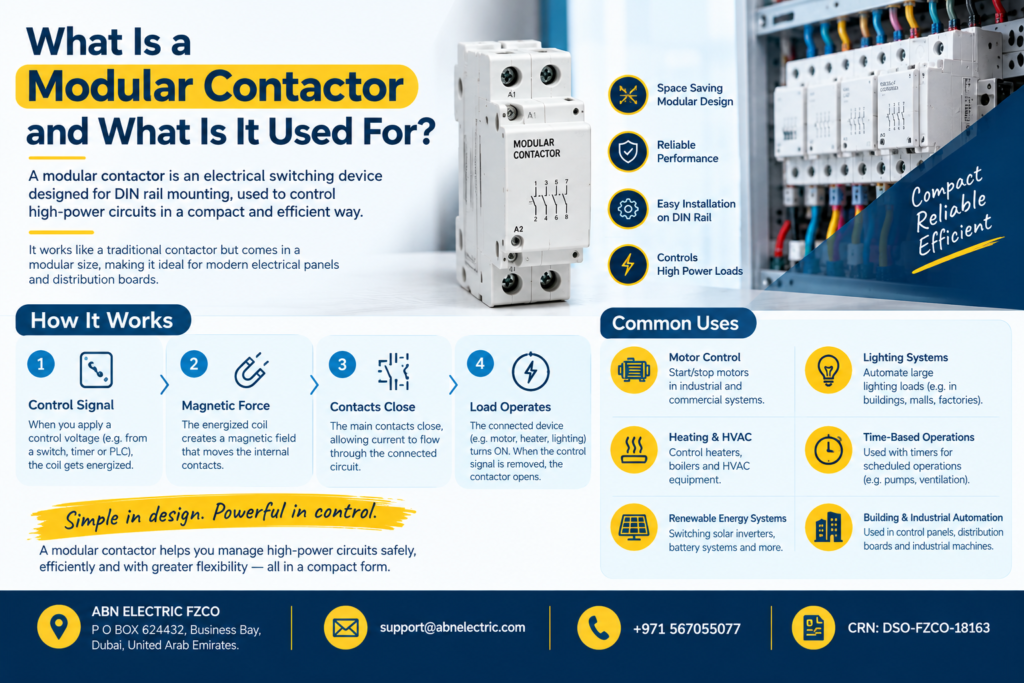
Quick answer: A modular contactor is a compact, DIN rail-mounted electrical switching device used to control lighting, heating, and other electrical loads remotely. Unlike traditional contactors, modular contactors are designed to fit neatly into modular distribution boards, making them a popular choice for residential, commercial, and industrial electrical installations across Dubai and beyond.
Electrical systems rely on dozens of components working together, but few are as quietly essential as the contactor. Among the many types available, modular contactors have become a go-to solution for engineers, contractors, and facility managers who need reliable load switching without sacrificing panel space.
Whether you’re specifying equipment for a new build or upgrading an existing distribution board, understanding what modular contactors are, how they work, and where they fit into an electrical system will help you make an informed decision. This guide breaks down the fundamentals in plain language, while still covering the technical details that electrical professionals need to know.
What Is a Modular Contactor?
A contactor, at its core, is an electrically controlled switch. It uses a small control signal to open or close a much larger circuit, allowing operators to switch electrical loads on and off remotely or automatically, without manually flipping a switch at the load itself.
What makes a contactor “modular” is its physical design. Modular contactors are built with a slim, compact housing that mounts directly onto a standard DIN rail, the same mounting system used for circuit breakers, residual current devices, and other modular electrical components. This design allows modular contactors to sit neatly alongside other devices inside a distribution board, rather than requiring a separate enclosure or additional panel space.
This compatibility with modular electrical distribution systems is one of the main reasons modular contactors have become so widely used. They integrate easily into existing panel layouts, which simplifies both new installations and future upgrades or replacements.
How Does a Modular Contactor Work?
The working principle behind a modular contactor is straightforward, even though the components involved are precise.
Inside every contactor are two main circuits: a control circuit and a load circuit. The control circuit carries a low-power signal, often from a switch, sensor, timer, or building automation system, to a coil inside the contactor. When this coil receives power, it generates a magnetic field.
That magnetic field pulls a set of internal electrical contacts together, closing the load circuit. This electromagnetic operation is what allows a small control signal to switch a much larger electrical load, such as a bank of lighting fixtures or a heating circuit, without any physical connection between the control side and the load side.
When the control signal stops, the magnetic field collapses, and the contacts separate, cutting power to the load. This cycle happens rapidly and can be repeated thousands of times, which is why contactors are suited to applications that require frequent switching.
What Is a Modular Contactor Used For?
Modular contactors are used to control a wide range of electrical loads where remote, automatic, or centralized switching is needed. Some of the most common applications include:
- Lighting control – Switching large lighting circuits in offices, retail spaces, or common areas, often integrated with timers or building management systems.
- Heating systems – Controlling electric heaters or heating elements that require on/off switching based on temperature or schedule.
- HVAC-related applications – Supporting the switching of fans, dampers, and auxiliary HVAC components.
- Water heaters – Managing power supply to water heating systems in residential and commercial buildings.
- Pumps – Switching pump motors in applications where the load falls within the contactor’s rated capacity.
- Motors where suitable – Depending on the motor’s current and starting characteristics, modular contactors may be used for smaller motor loads.
It’s worth noting that the appropriate contactor for any given application depends on several factors: the type of load, the voltage and current involved, the specific application requirements, and the manufacturer’s specifications. A contactor rated for lighting control, for example, won’t necessarily be suitable for a high-inrush motor load. Always cross-check the intended application against the manufacturer’s documentation before specifying a contactor.
Where Are Modular Contactors Commonly Used?
Because of their compact size and DIN rail compatibility, modular contactors show up in a wide variety of settings:
- Homes – Controlling lighting circuits, water heaters, or underfloor heating.
- Offices – Managing large lighting zones and HVAC-related switching.
- Commercial buildings – Integrated into building automation systems for centralized control.
- Hotels – Switching lighting and heating loads across multiple rooms or common areas.
- Retail spaces – Controlling signage, display lighting, and store-wide electrical loads.
- Industrial facilities – Supporting control panels for machinery and process equipment.
- Electrical control panels – Serving as the switching component within larger control and automation systems.
Across all these settings, the underlying goal is the same: reliable, space-efficient switching of electrical loads without the bulk of traditional switching equipment.
Key Benefits of Modular Contactors
Modular contactors offer several practical advantages that explain their popularity among electrical professionals:
- Compact design – Their slim housing takes up minimal panel space.
- Easy installation – DIN rail mounting simplifies both initial installation and future replacement.
- Efficient load control – Designed specifically for common load-switching applications like lighting and heating.
- Compatibility with modular distribution boards – Fits alongside breakers and other modular devices without extra hardware.
- Space-saving installation – Ideal for panels where space is limited.
- Integration with control systems – Works well with timers, sensors, and building automation platforms.
These benefits make modular contactors a practical choice for many standard switching applications, though as with any component, suitability should always be confirmed against the specific electrical requirements of the project.
Modular Contactors vs. Traditional Contactors
While modular and traditional contactors serve the same basic function, switching electrical loads, they differ in design, installation, and typical use cases.
| Feature | Modular Contactor | Traditional Contactor |
| Design | Compact modular design | Conventional contactor design |
| Mounting | Often DIN rail compatible | Depends on model |
| Space Requirement | Generally space-efficient | May require more panel space |
| Common Applications | Lighting, HVAC, building systems and similar loads | Motors and larger electrical loads depending on rating |
| Installation | Suitable for modular distribution systems | Application-dependent |
Neither type is universally “better.” Traditional contactors are often specified for heavier industrial loads or larger motors, where their design and rating suit the application. Modular contactors, by contrast, are typically chosen for lighting, heating, and similar loads where space efficiency and DIN rail compatibility offer a practical advantage. The right choice ultimately comes down to the specific load and installation requirements.
How to Choose the Right Modular Contactor
Selecting the correct modular contactor involves more than picking the first option available. Consider the following factors:
- Rated current – Match the contactor’s current rating to the load it will control.
- Rated voltage – Confirm compatibility with your system’s voltage.
- Coil voltage – Ensure the control circuit’s coil voltage matches your control system.
- Number of poles – Determine how many circuits need to be switched simultaneously.
- Contact configuration – Check whether normally open, normally closed, or combination configurations suit your application.
- Load type – Resistive, inductive, and motor loads may have different switching requirements.
- AC/DC requirements – Confirm whether your application requires AC or DC switching, where applicable.
- Frequency – Verify compatibility with your system’s operating frequency.
- Installation method – Confirm DIN rail compatibility and panel space.
- Electrical standards – Ensure the product meets relevant standards for your region and application.
Selection should always be based on the actual electrical application, not on price alone. A contactor that’s undersized for its load, or mismatched to its control circuit, can lead to premature failure or unsafe operation. When in doubt, consult the manufacturer’s technical documentation or speak with a qualified supplier.
Why Product Quality Matters
Choosing a properly specified modular contactor matters for more than just performance on paper. A well-matched contactor supports:
- Reliable operation – Reduces the likelihood of unexpected switching failures.
- Safe switching – Helps ensure the device operates within its intended electrical limits.
- Long-term performance – Quality components tend to hold up better under repeated switching cycles.
- Installation compatibility – A correctly specified contactor fits cleanly into existing modular distribution systems.
- Maintenance requirements – Reliable components can simplify ongoing maintenance and reduce troubleshooting time.
Exact performance figures, ratings, and certifications vary by manufacturer and model, so always refer to the specific product’s technical documentation before finalizing a purchase.
Choosing Modular Contactors in Dubai
For buyers and specifiers in Dubai, sourcing modular contactors involves a few additional considerations. Dubai’s mix of residential towers, commercial developments, hotels, and industrial facilities means electrical professionals often need components that meet a range of application requirements, from lighting control in a retail fit-out to heating control in a residential unit.
When choosing modular contactors in Dubai, it helps to focus on:
- Correct product specifications – Matching the contactor to the exact load and voltage requirements of the project.
- Application suitability – Confirming the contactor is appropriate for the intended use, whether lighting, heating, or another load type.
- Quality electrical components – Sourcing from suppliers who provide clear technical documentation.
- Reliable supplier support – Working with a supplier who can answer application-specific questions.
- Availability and proper installation – Ensuring the product is readily available and installed according to manufacturer guidelines.
ABN Electric offers a range of modular contactor solutions suited to residential, commercial, and industrial electrical installations. Readers researching modular contactors for an upcoming project can explore ABN Electric’s modular contactor range for further product information and specifications.
Making an Informed Decision on Modular Contactors
Modular contactors play a practical role in modern electrical systems, offering a space-efficient way to control lighting, heating, and other loads across homes, offices, and commercial facilities. Understanding how they work, where they’re used, and what factors matter during selection puts you in a stronger position to specify the right component for your project.
Before making a purchase, take the time to confirm your application’s load type, current rating, voltage, coil requirements, number of poles, and installation method. These details, checked against manufacturer documentation, will help ensure the contactor you choose performs reliably for years to come.
If you’re working on a project in Dubai and need guidance selecting the right modular contactor, ABN Electric’s team can help. Contact ABN Electric for product information, application guidance, and support finding a suitable electrical solution for your specific requirements.
Frequently Asked Questions
What is a modular contactor?
A modular contactor is a compact, electrically controlled switching device that mounts on a DIN rail. It uses a control circuit to switch electrical loads like lighting or heating on and off, and it’s designed to fit easily into modular electrical distribution boards.
What are modular contactors used for?
Modular contactors are commonly used to control lighting circuits, heating systems, water heaters, and certain pump or HVAC-related loads. The right application depends on the load type, current, and voltage requirements.
Where are modular contactors commonly installed?
They’re typically installed in homes, offices, commercial buildings, hotels, retail spaces, and industrial facilities, usually within electrical control panels or distribution boards.
How do I choose the right modular contactor?
Choosing the right modular contactor means matching its rated current, rated voltage, coil voltage, number of poles, and contact configuration to your specific load and application. Always check these details against the manufacturer’s product documentation.