
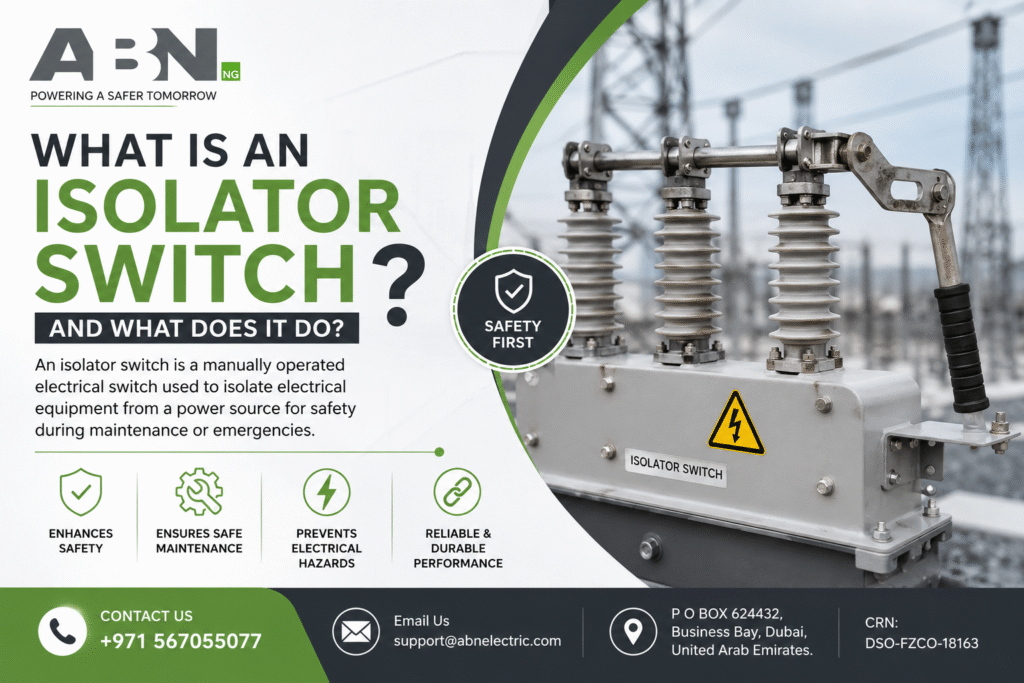
An isolator switch is a manual electrical device used to disconnect a circuit or piece of equipment from its power source. Unlike a circuit breaker, it provides no automatic protection—its sole purpose is to ensure safe, complete electrical isolation during maintenance, repairs, or emergencies. Isolator switches are essential components in residential, commercial, and industrial electrical systems worldwide.
Electrical safety is a critical part of every residential, commercial, and industrial power system. An isolator switch plays an important role by allowing electrical circuits to be safely disconnected during maintenance, repairs, or emergencies. Understanding how isolator switches work helps professionals choose the right electrical protection solution for safer and more reliable installations.
For electrical engineers, contractors, and facility managers working across Dubai and the UAE, selecting the correct isolator switch is not just a technical decision—it is a compliance and safety requirement. The wrong component can create serious risks, including equipment damage, electrical fires, and worker injuries. The right one, properly rated and installed, forms a reliable foundation for any electrical system.
This blog covers everything you need to know about isolator switches: how they work, where they are used, how they compare to MCBs, and what to look for before making a purchase.
What is an isolator switch, and why does it matter in electrical systems?
An isolator switch—also called an electrical isolator switch or power isolation switch—is a mechanical switching device designed to open an electrical circuit under no-load or minimal-load conditions. Its primary function is to provide a visible, confirmed point of disconnection, ensuring that a section of an electrical system is completely de-energized before any work begins.
The device does not provide automatic protection against faults like overloads or short circuits. Instead, it serves as a controlled means of achieving electrical isolation, making maintenance procedures safer for technicians and protecting sensitive downstream equipment. In electrical control systems, distribution boards, and industrial power systems, isolator switches are fundamental components.
The importance of electrical isolators extends across all sectors. From protecting HVAC systems in commercial buildings to isolating machinery in manufacturing plants, these devices support safe operational practices in line with international electrical safety standards.
How does an isolator switch work?
An isolator switch operates manually. When a technician or engineer turns the switch to the “off” position, it physically separates the circuit contacts, breaking the electrical path between the power source and the connected equipment. This creates a visible gap in the circuit, confirming that no current can flow.
Critically, isolator switches are designed to be operated only after the circuit load has been reduced or removed—typically after a circuit breaker has already interrupted the current. Operating an isolator switch under full load can cause dangerous arcing, which may damage the switch and create a safety hazard.
Once isolation is confirmed, engineers can safely carry out inspections, repairs, or upgrades on the de-energized section of the system. This process—known as electrical isolation—is a standard procedure in industrial electrical solutions and is required under most electrical safety regulations.
Why are isolator switches important for electrical safety?
Electrical safety depends on the ability to reliably de-energize any part of a system at any time. Isolator switches make this possible in a clear, controlled, and verifiable way. Without them, maintenance work on live circuits would be far more dangerous, increasing the risk of electrocution, arc flash, and equipment failure.
Beyond worker safety, isolator switches also protect equipment. When a machine or system section is isolated before servicing, the risk of accidental energization is eliminated. This reduces costly damage to motors, control panels, and other low voltage electrical equipment.
In industrial and commercial environments, the use of electrical safety switches is often mandated by local electrical codes and international standards such as IEC 60947. Compliance with these standards is not optional—it is a legal and operational requirement for facilities operating in Dubai and across the UAE.
Is an isolator switch the same as an MCB?
This is one of the most common questions among electrical professionals. While both devices appear in distribution boards and electrical panels, they serve very different purposes.
An MCB (Miniature Circuit Breaker) is an automatic circuit protection device. It trips instantly when it detects an overload or short circuit, cutting power to protect the circuit and connected equipment. An isolator switch, by contrast, provides no automatic protection. It is a manual device used solely to disconnect a circuit for safe access during maintenance.
The table below outlines the key differences:
| Feature | Isolator Switch | MCB |
| Main Purpose | Safe electrical isolation | Automatic circuit protection |
| Safety Function | Prevents accidental energization | Protects against overloads and short circuits |
| Circuit Protection | None (no automatic function) | Yes—trips on fault conditions |
| Manual Operation | Yes—manually operated only | Can be manually reset after tripping |
| Common Applications | Maintenance isolation, distribution boards, panels | Residential, commercial, and industrial circuit protection |
Some products—known as MCB isolators—combine isolation and circuit protection functions in a single unit, offering flexibility for space-constrained installations. ABN Electric supplies a range of MCB Isolators suited to both UL and non-UL applications.
Where are electrical isolator switches used?
Isolator switches appear across virtually every sector where electrical systems are installed. Their applications vary in scale and complexity, but the underlying purpose remains the same: safe, reliable disconnection.
Residential buildings use isolator switches at the main distribution board to allow homeowners and electricians to safely isolate circuits before carrying out repairs or upgrades. In commercial electrical installations, isolator switches protect everything from lighting systems to server rooms, allowing sections of a building to be de-energized independently.
Industrial power systems rely heavily on electrical isolation. Manufacturing plants, warehouses, and processing facilities use isolator switches to disconnect motors, conveyor systems, and production machinery during scheduled maintenance. HVAC systems in large commercial and industrial facilities also require dedicated isolators to allow safe servicing without shutting down the entire building’s power.
Additional common applications include:
- Electrical control systems and switchgear panels
- Distribution boards and sub-distribution boards
- Solar power and renewable energy systems
- Data centers and critical infrastructure
- Pumping stations and water treatment facilities
What are the main types of isolator switches?
Isolator switches are categorized primarily by the number of poles they control. Choosing the correct type depends on the electrical system’s configuration and the number of conductors that need to be isolated.
Single pole isolators disconnect only the live (phase) conductor. They are typically used in simple residential circuits where only the live wire needs to be isolated. Double pole isolators disconnect both the live and neutral conductors simultaneously, offering greater safety for appliances and equipment in residential and light commercial settings.
Three pole isolators are standard in three-phase industrial and commercial systems. They disconnect all three phase conductors at once, making them suitable for motors, pumps, and industrial machinery. Four pole isolators add a neutral pole to the three-phase configuration, which is essential in systems where the neutral conductor must also be isolated—particularly in TN-S and TT earthing systems.
MCB isolator units combine circuit breaker and isolation functionality, providing both protection and a safe disconnect point in one compact device. These are increasingly popular in modern distribution boards where space and efficiency are priorities.
What factors should you consider before buying an isolator switch?
Selecting the wrong isolator switch for an application can lead to equipment failure, safety violations, and costly replacements. The following factors are essential to evaluate before purchasing:
| Buying Factor | Why It Matters |
| Current Rating | Ensures safe operation without overheating or failure |
| Voltage Rating | Supports compatibility with the system’s operating voltage |
| Number of Poles | Matches the installation’s phase and neutral configuration |
| Safety Standards | Confirms compliance with IEC, UL, or applicable local standards |
| Product Quality | Ensures long-term reliability and consistent performance |
Beyond these technical criteria, consider the environment in which the isolator will be installed. Industrial environments may require IP-rated enclosures to protect against dust and moisture. In the UAE’s climate, components rated for high-temperature operation are particularly important. Always source electrical isolation solutions from suppliers who can confirm product certifications and offer technical support.
Why do businesses choose ABN Electric for isolator switch solutions in Dubai?
Sourcing reliable electrical components in Dubai requires more than browsing a catalog. Electrical engineers and procurement teams need a supplier who understands local standards, provides certified products, and can support technical decision-making.
ABN Electric is a trusted supplier of quality electrical components and low voltage electrical equipment serving businesses across Dubai and the UAE. Their product range includes isolator switches, MCB isolators, circuit protection devices, and a wide selection of electrical components for residential, commercial, and industrial applications.
ABN Electric’s approach centers on quality assurance and customer support. Their team works with contractors, facility managers, OEMs, and distributors to identify the right products for each specific application. Whether a project requires standard single-pole isolators or specialized MCB isolator solutions, ABN Electric provides reliable options backed by technical expertise.
For businesses seeking dependable electrical components and isolator switch solutions in the UAE, ABN Electric offers the product range and professional support needed to keep electrical systems safe and compliant.
Choosing the right isolator switch protects people, equipment, and operations
An isolator switch is one of the most straightforward yet most critical components in any electrical system. By providing a reliable, visible means of disconnection, it enables safe maintenance, reduces operational risk, and supports compliance with electrical safety standards. Choosing the right type—whether a single pole, three pole, or MCB isolator—depends on the system’s voltage, current, and configuration requirements.
For professionals and businesses in Dubai and the UAE, working with a knowledgeable supplier makes a meaningful difference. The right electrical components, properly specified and sourced, support safer installations and more reliable long-term performance.
Frequently Asked Questions (FAQs)
What is an isolator switch used for?
An isolator switch is used to manually disconnect a circuit or piece of equipment from its power source. It ensures safe electrical isolation during maintenance, repairs, or emergencies by providing a visible, confirmed break in the circuit before work begins.
Can an isolator switch be used instead of an MCB?
No. An isolator switch and an MCB serve different purposes. An MCB provides automatic protection against overloads and short circuits, while an isolator switch only provides manual disconnection. Both devices are often used together in distribution boards for complete circuit protection and safe isolation.
What happens if an isolator switch is operated under load?
Operating an isolator switch under full load can cause dangerous electrical arcing across the switch contacts. This can damage the switch, create a fire risk, and injure personnel. Isolator switches should only be operated after the circuit load has been removed or reduced using a circuit breaker.
How do I choose the right isolator switch for my system?
Select an isolator switch based on the system’s current rating, voltage rating, number of phases, and applicable safety standards. For guidance on choosing the correct product for your specific application in Dubai or the UAE, consult a qualified supplier such as ABN Electric.
Need the right isolator switch for your electrical system?
Contact ABN Electric for expert guidance on isolator switches, MCB isolators, and a full range of electrical components suited to residential, commercial, and industrial applications across Dubai and the UAE. Their team is ready to help you find the right solution for your project.