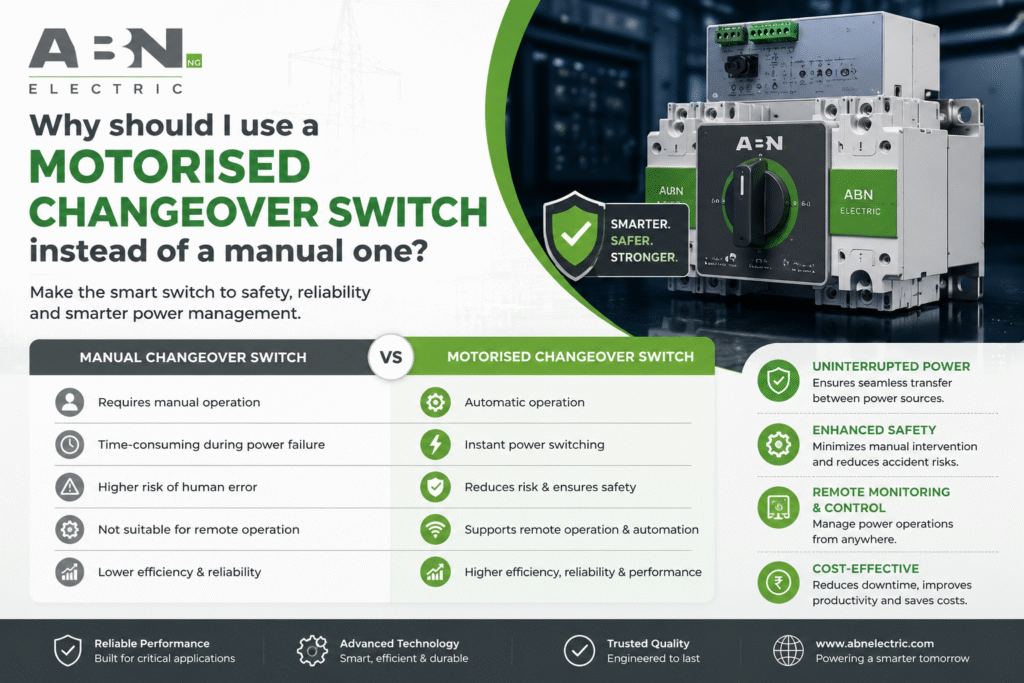
Motorised changeover switches automatically transfer power between sources without human intervention—typically within milliseconds. Manual changeover switches require a person to physically operate them, which introduces delays, safety risks, and the possibility of human error. For businesses that depend on uninterrupted power, motorised changeover switches deliver faster response, greater reliability, and significantly reduced operational downtime.
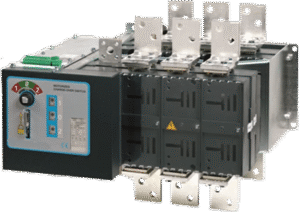
Reliable power supply is essential for businesses, industries, and commercial facilities where even a short interruption can affect operations. While manual changeover switches have been used for years, modern businesses are increasingly choosing automated solutions for faster, safer, and more efficient power transfer. Understanding why motorised changeover switches offer advantages over manual alternatives can help you select the right solution for your electrical system.
Power failures rarely announce themselves. When the grid goes down unexpectedly, every second counts—and the difference between a two-second automated switchover and a two-minute manual one can mean thousands of dollars in lost productivity, damaged equipment, or compromised safety systems. That’s a gap no business can afford to ignore.
This guide breaks down how both switch types work, where each falls short, and why facilities across Dubai and the UAE are making the shift to automated power transfer solutions.
What Is a Motorised Changeover Switch?
A motorised changeover switch is an electrical device that automatically transfers a load from one power source to another—typically from a main utility supply to a backup generator—without requiring manual operation.
The switch uses an electric motor-driven mechanism to detect supply failure and execute the transfer. Once the primary power source is restored, the switch returns the load automatically. This entire process can happen within milliseconds, depending on the system configuration.
Motorised changeover switches are a core component of modern power management systems. They are often used alongside automatic transfer switches (ATS) and integrated into broader building or industrial automation setups. When connected to a motorised changeover switch system, facilities gain real-time control, remote monitoring capability, and a reliable mechanism that operates consistently—regardless of whether a technician is on site.
How Does a Manual Changeover Switch Work?
A manual changeover switch performs the same basic function—redirecting power from one source to another—but requires a person to physically operate it.
When a power failure occurs, the operator must:
- Recognize that the main supply has failed
- Locate and access the switch panel
- Manually turn or switch the lever to the backup source
- Start the backup generator if it isn’t running automatically
This process typically takes several minutes. In facilities where power continuity is critical, those minutes carry real consequences. Hospitals may lose lighting in procedure rooms. Data centres may experience data corruption. Manufacturing lines may require costly restarts.
Manual changeover switches also introduce a human error variable. An operator under pressure may switch incorrectly, creating dangerous back-feeding scenarios or equipment damage.
Motorised vs Manual Changeover Switch: Which One Is Better?
The answer depends on your requirements—but for most commercial and industrial applications, motorised changeover switches are the stronger choice.
| Feature | Motorised Changeover Switch | Manual Changeover Switch |
| Operation | Automatic control | Manual operation |
| Response Time | Faster switching | Depends on human action |
| Safety | Reduced human involvement | Requires manual handling |
| Convenience | Higher automation | Requires physical effort |
| Reliability | Suitable for critical applications | Limited during emergencies |
Manual switches suit low-risk environments where occasional outages are tolerable and budget is a primary constraint. Motorised systems are preferable when uptime, safety, and operational continuity are non-negotiable.
Why Are Businesses Moving From Manual to Motorised Changeover Switches?
The shift toward electrical automation is driven by three converging factors: growing infrastructure complexity, stricter safety standards, and the rising cost of downtime.
A single hour of unplanned downtime can cost a manufacturing facility tens of thousands of dollars. For a hospital or data centre, the stakes are even higher. Businesses are realizing that manual changeover systems were designed for a simpler era—one where facilities were smaller, power demands were lower, and outages were rarer.
Motorised systems align with modern power management expectations. They integrate with building management systems (BMS), support remote monitoring, and generate operational data that helps engineers optimize energy use over time.
Major Benefits of Using Motorised Changeover Switches
Faster Power Transfer
The most immediate advantage is speed. A motorised changeover switch detects supply failure and completes the transfer in milliseconds—far faster than any manual process. For sensitive equipment like servers, medical devices, or CNC machines, this speed difference is critical to avoiding damage or data loss.
Improved Safety
Manual switching requires a technician to interact physically with live electrical systems under stress conditions. This creates real risk of arc flash, electric shock, or incorrect operation. Motorised changeover switches eliminate this exposure. The switch handles the transfer automatically, keeping personnel away from the panel during the most dangerous moments of an outage.
Better Reliability
Automated systems don’t get distracted, delayed, or confused. A motorised changeover switch executes the same sequence consistently, every time. This consistency is especially valuable in facilities that run 24/7, where shift changes and staffing gaps could otherwise compromise response times.
Remote Monitoring and Control
Modern motorised changeover switches integrate with SCADA systems, BMS platforms, and remote monitoring dashboards. Facility managers can check switch status, receive outage alerts, and even trigger manual overrides from a smartphone or control room. This level of visibility simply isn’t possible with a traditional manual changeover switch.
Reduced Operational Downtime
Faster transfer plus fewer errors equals less downtime. For commercial and industrial operations, reduced downtime translates directly into preserved revenue, protected equipment, and maintained service delivery. Automatic power switching solutions make power continuity a system function—not a personnel-dependent variable.
The Hidden Problems With Traditional Manual Changeover Systems
Manual changeover switches look straightforward on paper. In practice, they create operational vulnerabilities that only become visible during emergencies.
Consider these real-world scenarios:
- After-hours failure: A power outage occurs at 3 a.m. The on-call technician takes 20 minutes to arrive and manually switch over. Production is lost, and refrigeration systems are compromised.
- Untrained staff: The usual technician is unavailable. A less experienced team member switches incorrectly, back-feeding the grid and damaging equipment.
- Repeated outages: Multiple outages in a single week mean repeated manual interventions, increasing fatigue, error risk, and wear on the switch mechanism.
These aren’t edge cases—they’re predictable failure modes. Motorised changeover switches remove the human bottleneck entirely.
Where Are Motorised Changeover Switches Commonly Used?
| Application | Why Motorised Changeover Switches Help |
| Industries | Maintain continuous operations |
| Commercial Buildings | Improve power reliability |
| Generators | Enable automatic power transfer |
| Critical Facilities | Reduce downtime risks |
More specifically, motorised changeover switches are deployed across:
- Industrial facilities: Factories, manufacturing plants, and processing facilities where production continuity is directly tied to revenue
- Commercial buildings: Office towers, retail centres, and mixed-use developments requiring reliable power for tenants and common areas
- Data centres: Environments where milliseconds of downtime can corrupt data or trigger SLA penalties
- Hospitals and healthcare: Critical care units, operating theatres, and medical imaging equipment cannot tolerate supply interruptions
- Residential complexes: High-rise developments using generator backup systems for lifts, pumps, and emergency lighting
- Generator backup systems: Any facility with a standby generator benefits from automatic power transfer rather than manual intervention
Why Businesses in Dubai Prefer Automated Power Solutions
Dubai’s infrastructure operates at a scale and pace that demands electrical reliability. The emirate’s commercial and industrial sectors—spanning logistics, manufacturing, hospitality, healthcare, and data services—run continuous operations across facilities that cannot absorb unplanned downtime.
Dubai’s summer temperatures also place extreme demand on cooling systems. An outage that takes minutes to resolve manually can push HVAC systems into thermal overload conditions. Automatic changeover to backup power prevents these cascading failures.
Regulatory expectations and international standards increasingly require critical facilities to demonstrate verifiable power continuity measures. Motorised changeover switches, with their automated logging and monitoring capabilities, make compliance documentation far more manageable.
As Dubai continues expanding its industrial and commercial base, demand for low voltage electrical equipment and intelligent power management systems will only increase. Businesses investing in automated electrical changeover switch solutions today are positioning themselves for both operational resilience and regulatory readiness.
How to Choose the Right Motorised Changeover Switch
Selecting the correct motorised changeover switch requires careful assessment of several factors:
- Power requirements: Determine the total load the switch must handle, including peak demand scenarios
- Load capacity: Choose a switch rated above your maximum anticipated load to ensure safe, reliable operation
- System compatibility: Verify that the switch integrates with your existing power distribution architecture and any BMS or SCADA platforms
- Installation requirements: Consider physical panel space, cable routing, and whether the installation requires a neutral position for safe transition
- Quality standards: Look for switches that comply with IEC standards and carry appropriate certifications for your application
Engaging an experienced electrical solutions provider early in the selection process prevents costly misspecification.
What Makes ABN Electric a Trusted Source for Motorised Changeover Switches in Dubai?
ABN Electric supplies a comprehensive range of industrial electrical components and power management solutions across Dubai and the UAE. With deep technical knowledge of commercial and industrial electrical requirements, ABN Electric supports clients from product selection through to installation guidance.
Their electrical changeover switch solutions are sourced from reputable manufacturers and meet the quality standards expected in demanding applications. Whether you’re equipping a new industrial facility, upgrading an existing building’s backup power system, or expanding a data centre, ABN Electric provides the technical support needed to identify the right solution.
ABN Electric understands that buying an electrical component is only part of the process—what facilities managers and engineers actually need is a reliable partner who can help them make the right decision the first time.
Final Thoughts: Is a Motorised Changeover Switch Worth the Investment?
The short answer is yes—for any facility where downtime, safety, or operational continuity matters.
Manual changeover switches still have a role in low-criticality, budget-constrained environments. But for most modern commercial and industrial applications, the speed, safety, and reliability advantages of motorised changeover switches deliver a return on investment that is both measurable and significant.
As electrical automation becomes the standard—not the exception—facilities that continue relying on manual switching are accepting a level of operational risk that is increasingly difficult to justify.
Choosing the right power switching solution can improve safety, reliability, and operational efficiency. Contact ABN Electric today to discuss your electrical requirements and find the right motorised changeover switch solution for your application.
Frequently Asked Questions (FAQs)
What is the main difference between a motorised and a manual changeover switch?
A motorised changeover switch transfers power automatically without human intervention, typically within milliseconds. A manual changeover switch requires a person to physically operate it. This means motorised systems respond faster, reduce human error, and are better suited to critical power management applications.
Are motorised changeover switches suitable for generator backup systems?
Yes. Motorised changeover switches are widely used in generator changeover switch applications. When the main supply fails, the switch automatically starts the generator sequence and transfers the load. This eliminates the delays and risks associated with manual switching during outages.
How do I know which motorised changeover switch is right for my facility?
The right switch depends on your load capacity, system voltage, integration requirements, and application type. An experienced electrical solutions provider—like ABN Electric in Dubai—can assess your specific requirements and recommend a suitable automatic changeover switch that meets your operational and safety needs.
Can motorised changeover switches be monitored remotely?
Yes. Modern motorised changeover switches can integrate with building management systems and remote monitoring platforms. This allows facility managers to track switch status, receive fault alerts, and manage power transfer operations from a central control point—improving overall energy management and operational visibility.